Skip to content

Agent State Management

Checkpointers keep a conversation alive between turns. Long-term memory keeps what matters alive between conversations. This toolkit provides both on managed cloud databases for LangGraph, CrewAI, Strands and PydanticAI, plus the one piece none of the frameworks ship: a way to move history from the first to the second at the right moment, through the reducer's on_prune hook, with no package coupling.

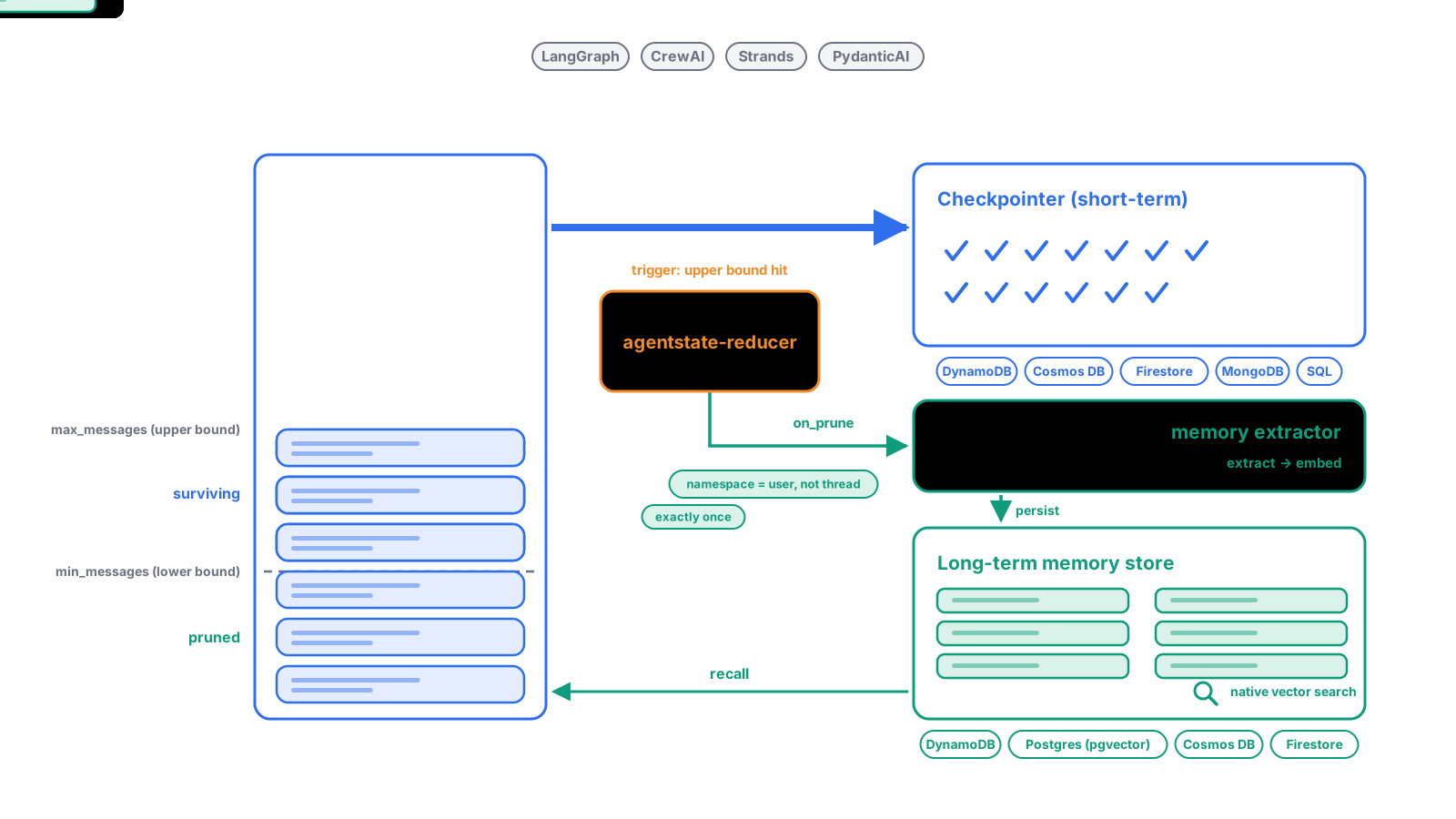
Animated flow: messages fill a bucket between min and max bounds; every message is checkpointed; at the upper bound the reducer prunes the oldest messages down to the lower bound, hands them through on_prune to a memory extractor and long-term store, and a new conversation later recalls them
Backends shown are illustrative; the table below is the precise map.

What the animation shows

  1. The window is a bucket with two waterlines. Messages stack up between min_messages and max_messages. Every new message is checkpointed immediately — the tick mark appearing on the checkpointer each time a bubble lands. Short-term state is always current.
  2. Nothing else happens until the upper bound is hit. That is the only moment agentstate-reducer acts. It lifts the oldest messages out until the stack sits at the lower bound. The surviving messages are checkpointed as usual.
  3. The pruned messages are not thrown away. The reducer hands them to its on_prune hook. That hook calls a memory extractor, which turns turns into facts and embeddings, and writes them into the long-term store. Two details ride along: the namespace is the user, not the thread, so memory outlives any single conversation, and each message is delivered to the on_prune hook exactly once even though checkpointers save several times per turn.
  4. The sawtooth repeats. Fill to the upper bound, cut to the lower, fill again. Checkpoint writes are constant; long-term writes are rare and deliberate.
  5. A new conversation recalls. The next thread starts empty and pulls relevant memories back by semantic search on the user's namespace.

The part nobody else ships: an automatic route from checkpoint to long-term memory that cannot become a bottleneck

Every framework has a checkpointer and a store. None of them connects the two. Here the connection is inside the checkpointer's save path, so it needs no extra node, callback or scheduler, and it is built not to slow that path down: Background(...) runs the hook on a bounded worker pool off the request, each message is delivered exactly once, and a hook that raises is logged and skipped, never failing the checkpoint. The checkpoint write costs the same with or without memory.

Who sits where

The reducer is the same package in every column and every row. What changes per framework is which of our packages plays checkpointer and store, and which extractor you plug into the reducer's on_prune hook.

Framework Checkpointer (short-term) Extractor, plugged into the reducer's on_prune hook Store (long-term)
LangGraph langgraph-dynamodb-checkpoint · langgraph-checkpoint-cosmosdb · langgraph-checkpoint-firestore, or any other saver through ReducingSaver langgraph-memory (ours: extract, consolidate, recall by similarity + recency + importance), or LangMem (dormant), or your own langgraph-store-dynamodb · -postgres · -cosmosdb · -firestore (BaseStore, native vector search)
CrewAI crewai-persistence-dynamodb · -mongodb · -sql · -cosmosdb · -firestore (Flow state) CrewAI Memory.extract_memories, the framework's own engine crewai-memory-dynamodb · -postgres · -cosmosdb · -firestore (StorageBackend, native vector search)
Strands strands-session-dynamodb · -mongodb · -sql and strands-*-storage — sessions only; the reducer is not in Strands' save path, so call reduce() yourself to get on_prune Strands ModelExtractor via MemoryManager strands-dynamodb-store · strands-postgres-store · strands-mongodb-store (MemoryStore, native vector search)
PydanticAI pydantic-ai-dynamodb-persistence · -cosmosdb- · -firestore- (StepStore, history) the harness expects the model to write via write_memory; from the hook, append_memory does a CAS-safe append pydantic-ai-dynamodb-memory · -cosmosdb- · -firestore- · -postgres- (harness MemoryStore, notebook files)

The extractor is pluggable, on purpose. How do I plug one in?

The checkpointer and store columns are ours. The extractor column is mostly not: CrewAI's memory engine and Strands' extractor already do that job, and they keep improving. The one exception is LangGraph, where the ecosystem's engine (LangMem) went dormant, so we ship langgraph-memory. Either way the reducer's on_prune hook is the socket: it hands your extractor the pruned messages and the namespace, exactly once, and imports none of them — so you can swap engines without touching the reducer, the checkpointer or the store. The linked page has a working snippet for every row of the table.

Three things worth knowing before you pick

  • You do not need all three columns. A checkpointer alone gives you resumable conversations. Checkpointer plus reducer gives you bounded context and cost. The store and the reducer's on_prune hook only matter once you want memory across conversations.
  • Every store does semantic search natively on LangGraph, CrewAI and Strands: DynamoDB SearchVectors, pgvector, Cosmos VectorDistance, Firestore find_nearest, MongoDB Vector Search. No separate vector database. PydanticAI's harness store is a versioned notebook with lexical search, by upstream design.
  • The namespace is the app's decision. In LangGraph it rides in configurable, in CrewAI in flow state, in PydanticAI in deps. The integration forwards it to the reducer's on_prune hook; the reducer never guesses.

Package reference

Pruning core

Package What it does PyPI
agentstate-reducer Framework-agnostic message pruning — by message count or token budget — plus on_prune long-term memory hooks and ReducingSaver for any LangGraph checkpointer agentstate-reducer

LangGraph checkpointers (with built-in pruning)

Package Backend PyPI
langgraph-checkpoint-cosmosdb Azure CosmosDB langgraph-checkpoint-cosmosdb
langgraph-checkpoint-firestore Google Firestore langgraph-checkpoint-firestore
langgraph-dynamodb-checkpoint AWS DynamoDB langgraph-dynamodb-checkpoint
Package Backend PyPI
langgraph-store-core shared base + IndexConfig semantic search langgraph-store-core
langgraph-store-dynamodb AWS DynamoDB (native SearchVectors) langgraph-store-dynamodb
langgraph-store-postgres PostgreSQL (pgvector) langgraph-store-postgres
langgraph-store-cosmosdb Azure Cosmos DB (VectorDistance) langgraph-store-cosmosdb
langgraph-store-firestore Google Firestore (find_nearest) langgraph-store-firestore

LangGraph memory engine — extraction, consolidation, recall

Package What it does PyPI
langgraph-memory LLM fact extraction, insert/update/skip consolidation, recall ranked by similarity + recency + importance over any indexed BaseStore; on_prune hook, agent tools, recall node langgraph-memory

CrewAI Flow persistence (with built-in pruning)

Package Backend PyPI
crewai-persistence-cosmosdb Azure CosmosDB crewai-persistence-cosmosdb
crewai-persistence-firestore Google Firestore crewai-persistence-firestore
crewai-persistence-dynamodb AWS DynamoDB crewai-persistence-dynamodb
crewai-persistence-mongodb MongoDB crewai-persistence-mongodb
crewai-persistence-sql Any SQLAlchemy DB crewai-persistence-sql
Package Backend PyPI
crewai-memory-core shared base for CrewAI StorageBackends crewai-memory-core
crewai-memory-dynamodb AWS DynamoDB (native SearchVectors) crewai-memory-dynamodb
crewai-memory-postgres PostgreSQL (pgvector) crewai-memory-postgres
crewai-memory-cosmosdb Azure Cosmos DB (VectorDistance) crewai-memory-cosmosdb
crewai-memory-firestore Google Firestore (find_nearest) crewai-memory-firestore

PydanticAI persistence (StepStore + history)

Package Backend PyPI
pydantic-ai-persistence core + in-memory pydantic-ai-persistence
pydantic-ai-dynamodb-persistence AWS DynamoDB pydantic-ai-dynamodb-persistence
pydantic-ai-cosmosdb-persistence Azure CosmosDB pydantic-ai-cosmosdb-persistence
pydantic-ai-firestore-persistence Google Firestore pydantic-ai-firestore-persistence

PydanticAI memory backends — long-term memory (harness MemoryStore)

Package Backend PyPI
pydantic-ai-memory-core shared base for harness MemoryStores (CAS + receipts) pydantic-ai-memory-core
pydantic-ai-dynamodb-memory AWS DynamoDB (conditional writes) pydantic-ai-dynamodb-memory
pydantic-ai-cosmosdb-memory Azure Cosmos DB (ETag CAS) pydantic-ai-cosmosdb-memory
pydantic-ai-firestore-memory Google Firestore (transactions) pydantic-ai-firestore-memory
pydantic-ai-postgres-memory PostgreSQL (upstream store, from a URL) pydantic-ai-postgres-memory

Strands sessions

Package Backend PyPI
strands-agents-session core (session manager) strands-agents-session
strands-agents-session[dynamodb] AWS DynamoDB strands-agents-session-dynamodb
strands-agents-session[mongodb] MongoDB strands-agents-session-mongodb
strands-agents-session[sql] Any SQLAlchemy DB strands-agents-session-sql

Quick Taste

from agentstate_reducer import MessageReducer

reducer = MessageReducer(min_messages=10, max_messages=20)
result = reducer.reduce(existing=messages, new=new_messages)
print(result.surviving)  # capped list
from agentstate_reducer import MessageReducer
from langgraph_checkpoint_cosmosdb import CosmosDBSaver

saver = CosmosDBSaver(
    database_name="mydb",
    container_name="checkpoints",
    reducer=MessageReducer(min_messages=10, max_messages=20),
)
from agentstate_reducer import MessageReducer, ReducerConfig
from langgraph_dynamodb_checkpoint import DynamoDBSaver

def remember(pruned, namespace):          # any BaseStore / LangMem / engine
    for m in pruned:
        store.put(namespace, key=m.id, value={"content": m.content})

saver = DynamoDBSaver("checkpoints",
    reducer=MessageReducer(config=ReducerConfig(max_messages=20, on_prune=[remember])))

graph.invoke(input, config={"configurable": {
    "thread_id": thread_id,                          # short-term scope
    "memory_namespace": ("memories", user_id),       # long-term scope
}})
from crewai.flow.persistence import persist
from crewai_persistence_firestore import FirestoreFlowPersistence
from agentstate_reducer import MessageReducer

@persist(FirestoreFlowPersistence(
    project_id="my-project",
    reducer=MessageReducer(min_messages=10, max_messages=20),
))
class MyFlow(Flow[MyState]):
    ...

Where to Start